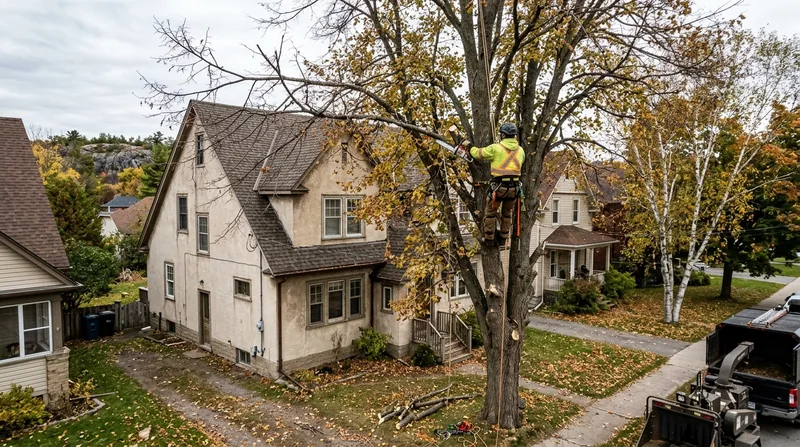




Dead branches in a mature silver maple are not a cosmetic issue. They are weight waiting for the right gust, and in Sudbury that gust arrives with every ice storm and summer windstorm. Our deadwood removal in Sudbury targets the limbs that are already dead, broken or hanging by fibre, and takes them down before gravity does. We have worked the Sudbury area since 2011, from ravine lots with steep access to post-war subdivisions where the street trees are now eighty years old. Our ISA Certified Arborists assess the canopy, identify what is structurally sound and what has to come out, and remove it with rigging that protects your roof, your vehicle and the fence line. If a limb is already down, see our storm damage cleanup service.
Why deadwood becomes a real risk in Sudbury
Sudbury sits in a freeze-thaw cycle that opens cracks in bark and lets water into the wood. Silver and sugar maples, red and white oaks and birches all shed small deadwood every year, and that is normal. What is not normal is a limb that has been dead for two or three seasons: it dries, loses flexibility and snaps under snow load rather than bending. Ash killed by the emerald ash borer is the worst case, because the tree holds its dead structure while the wood inside turns brittle.
We look for the signs that matter:
- Branches with no buds, no leaves in summer, or bark peeling off in strips.
- Limbs crossing over a roof, a driveway or a hydro service entrance.
- Cracks at the branch collar where the limb meets the trunk.
- Fungal conks or soft wood at the base of a large limb.
- Hangers caught in the crown after a windstorm, still attached at one end.
Any one of these is enough to justify an inspection before the snow arrives. Two or more together usually mean the limb comes out this season.
Key fact: a dead limb 15 centimetres in diameter and 4 metres long can weigh over 100 kilograms. Falling from 12 metres, it reaches the ground with enough force to crush a car roof or punch through a garage deck. That is the calculation we make before we cut, not after.
For the provincial picture on tree care and private property responsibilities, the in Sudbury and the surrounding area Ministry of Natural Resources and Forestry publishes guidance at ontario.ca.
How our crews remove deadwood
Every job starts with a climb or a bucket assessment, not a chainsaw. One of our ISA Certified Arborists reads the tree from the ground, then from inside the canopy, and marks each limb to be removed. We work from the top down and from the outside in, so the tree stays balanced while we cut. On tight lots in Sudbury neighbourhoods, we rig every piece on a rope and lower it controlled rather than let it drop.
- We inspect the tree and confirm which limbs are dead, which are dying and which are healthy but badly placed.
- We set up rigging and drop areas, and protect roofs, fences, decks and vehicles with pads and plywood.
- We remove deadwood with pole saws, chainsaws and hand saws, making the final cut at the branch collar so the tree can seal the wound.
- We lower large pieces on rigging lines and process them on the ground.
- We chip the brush and leave the wood, or haul it away if you prefer.
- We rake the work area and walk the property with you before we leave.
Nothing leaves the site until you have seen the finished canopy and signed off on the cleanup.
Key fact: on a ravine lot off the Sudbury area with a 20 metre slope behind the house, we removed eleven dead limbs from two mature oaks using a 60-tonne crane and rigging rather than climbing spikes. The work took one day, the lawn was untouched, and no piece larger than a dinner plate reached the ground uncontrolled.
If the deadwood sits over a private service entrance, our hydro line clearance service covers the approach distances. Anything touching the public distribution network is referred to your local utility or Hydro One, and we do not work on those lines.
Methods we use, and when each one applies
The right method depends on the height, the species and what sits under the limb. A dead branch over an empty back lawn can come down in one piece. The same branch over a slate roof in Uptown needs rigging and a controlled lower. We choose per limb, not per tree.
| Method | Description | Context |
|---|---|---|
| Hand saw and pole saw | Small deadwood up to 10 centimetres cut from a ladder or from inside the canopy. | Ornamental trees, fruit trees, light cleanup after a windstorm. |
| Climbing with rigging | Arborist ascends, ties off each limb and lowers it on a rope to a ground worker. | Tight backyards reachable only through a standard gate, limbs over roofs and fences. |
| Bucket truck | Articulated lift reaches the canopy from the street or driveway. | Mature street trees in post-war subdivisions, clear access from the road. |
| Crane assisted removal | Crane lifts large dead sections in one piece and sets them on the truck. | Very large limbs, ravine lots with steep access, trees too compromised to climb. |
| Cabling and bracing | Steel cable supports a weak crotch or a heavy limb that is still alive. | Heritage trees where removal is not the first option. |
We match the method to the tree, not the other way around. If you want to know which method fits your property, the tree pruning service explains how we combine deadwood removal with structural pruning in one visit.
Permits, setbacks and debris in the Sudbury area
Deadwood removal on a living tree is maintenance, not removal, and most of it needs no municipal approval. The picture changes if the assessment shows the tree itself is failing and has to come down: the City of Sudbury may require a permit for a private tree removal, and the application is normally supported by an arborist report. Rules and thresholds differ from one municipality to the next across the Sudbury area, so we check before we cut, not after. Our arborist report service produces the document the city asks for.
On site, we respect approach distances near private electrical service entrances and never touch the public distribution network. Brush goes through the chipper and the chips leave with us unless you want them for garden beds. Larger wood is cut to firewood length and stacked, or hauled away, whichever you choose. Our brush chipping service handles the volume on larger properties, and our firewood service takes the rounds if you burn wood.
When to schedule deadwood removal
The best window for deadwood removal is dormancy, from late fall to late winter. The canopy is bare, the structure is visible, and the tree is not spending energy on growth, so a clean cut at the branch collar seals faster in spring. Late winter also puts you ahead of the snow season, which is when dead limbs cause the most damage in the Sudbury area. Summer work is fine when a limb is already cracked or hanging, and we handle those calls year-round.
Ice storms and summer windstorms drive our emergency volume, and a dead limb that survived one storm is not guaranteed to survive the next. If a branch is down now, call (249) 806-5249 and we will assess the same day where access allows. For non-urgent work, book an inspection before the first heavy snowfall and we will put the removal on the schedule.
To compare what a visit costs against other canopy work, the full pricing grid lists our rates. Deadwood removal starts at $225 for a small ornamental tree and scales with height, access and the volume of wood. You get a written free estimate before any saw starts.
Prices Deadwood Removal in Sudbury — Indicative pricing
| Service | Price | Details |
|---|---|---|
| Small ornamental tree, deadwood only | From $225 | Up to 6 metres, hand saw and pole saw, brush chipped and hauled |
| Mature tree, standard access | From $475 | Climbing and rigging, limbs lowered, roof and fence protection included |
| Large canopy or tight backyard | From $850 | Bucket truck or rigging through a standard gate, multiple dead limbs |
| Crane assisted removal | On estimate | Ravine lots, very large limbs, trees too compromised to climb |
| Travel | Included | In Sudbury and the surrounding area |
| Estimate | Free | Written, no obligation, reply within 24 hours at (249) 806-5249 |
Indicative prices; free, personalized estimate within 24h at (249) 806-5249.