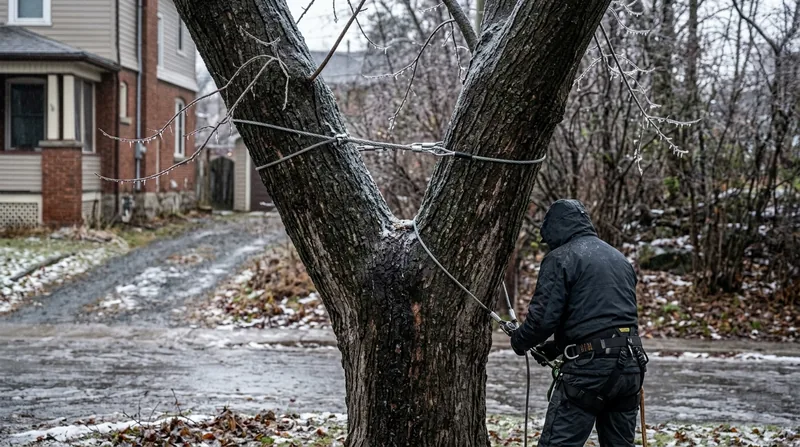




Tree cabling and bracing in Sudbury is the work of holding a mature tree together when a fork or a limb has started to split. Silver and sugar maples, red and white oaks and black locusts across the Sudbury area grow in heavy clay, on ravine lots and along post-war residential streets, and many of them carry old storm damage in their crowns. Our ISA Certified Arborists inspect the tree first, confirm it is sound enough to keep, then install flexible cables and steel rods that share the load through wind, snow and ice. We have been doing this work since 2011, fully insured, and we document every installation so you can show it to your insurer. If a tree is past saving, we say so and point you to tree removal instead. Call (249) 806-5249 to book a free estimate.
Why cabling and bracing matters on mature trees in Sudbury
Sudbury sits on the Canadian Shield, and the shallow soil over bedrock pushes roots sideways rather than down. Add lake-effect snow, ice storms and summer windstorms, and the weak forks in old maples and oaks become the first place a tree fails. A split fork that goes unnoticed in summer can open fully under the first ice load of December. Cabling does not heal the tree, but it buys decades of safe life for a specimen you cannot replace.
- We inspect the fork, the bark ridge and the root flare before recommending anything.
- We install flexible cables in co-dominant stems to limit the spread under load.
- We add steel rods through split unions where a cable alone cannot hold the wood.
- We record the hardware and the date so future inspections start from facts.
Every installation starts with an honest assessment: if the tree is not sound, we will not sell you a cable.
Key fact: a mature silver maple in a Downtown Sudbury backyard, with a split fork at 4 metres and a house within 6 metres, typically needs two flexible cables and one rod. Budget from $650, and expect the work to take half a day with a two-person crew.
in Sudbury and the surrounding area residents can check tree care guidance from the Government of in Sudbury and the surrounding area before deciding on any structural work.
How we install cables and braces
Our crews work from the ground up, not from a bucket truck whenever the tree allows it. A standard gate is often the only access to a tight backyard in Sudbury neighbourhoods, so we plan the climb, the rigging and the hardware before we touch the tree. The sequence below is what you can expect on a typical job.
- We inspect the tree from the root flare to the crown and measure the fork and the span.
- We confirm the tree is sound enough to keep and explain the alternative if it is not.
- We drill and set the rod through the split union, then tighten it to close the gap.
- We install the flexible cable at the correct height, typically two-thirds of the distance from the fork to the crown.
- We prune deadwood around the installation so the new hardware is not loaded by failing branches.
- We photograph the finished work and hand you a written record for your files.
The job is finished when the hardware is set, the crown is clean and you understand what to watch for next season.
Key fact: on a ravine lot near the French River, a red oak with a 30 cm split at 6 metres needed a through-rod and two cables. The crew reached the site on foot through a narrow path, and the installation took a full day. Expect from $850 for that kind of access.
If the crown also carries dead limbs, pair the cabling with our deadwood removal service so the tree is not fighting two problems at once.
Methods we use, and when each one fits
Not every weak tree needs the same hardware. We choose the method from the species, the fork geometry and the load the tree carries. The table below sets out what we install and the situations where each method makes sense.
| Method | Description | Context |
|---|---|---|
| Flexible steel cable | A stranded cable set high in the crown to limit the spread of co-dominant stems. | Mature maples and oaks with a narrow fork and a history of wind damage. |
| Through-rod | A steel rod drilled through a split union and secured with washers and nuts. | A fork that has already opened and needs the wood pulled back together. |
| Cable and rod combined | A rod through the union plus one or two cables above it to share the load. | Large specimens close to a house, a driveway or a hydro service entrance. |
| Crown reduction with support | Targeted pruning to lower the sail area, followed by cabling where needed. | Trees on exposed lots where wind loads are high and removal is not an option. |
The right method comes from the inspection, not from a catalogue, and we will tell you when a cable is not worth the money.
Permits, clearances and cleanup around the work
Before any hardware goes in, we check what the site allows. The City of Sudbury may require a permit for a private tree removal, and an arborist report normally supports that application; the same report can document the condition of a tree you intend to keep and cable. Rules differ from one municipality to the next across the Sudbury area, so we confirm the local requirement before the crew arrives. Near a private electrical service entrance, we respect the approach distances, and we never touch the public distribution network: a tree touching the public lines is referred to your local utility or Hydro One. All brush and offcuts leave the site with us, and we chip what can be chipped through our brush chipping service.
If you need written documentation for a permit or an insurer, our arborist report covers the tree's condition, the recommended hardware and the risk before and after the work. You can also review our pricing page for the range of structural work we handle.
When to schedule cabling and bracing in the Sudbury area
The best window for structural work is dormancy, from late fall to late winter, when the crown is bare and the fork is easy to read. Ice storms and summer windstorms can create urgent cases at any time of year, and we handle those as they come. If the tree has already split, do not wait for spring: call (249) 806-5249 and we will assess it within the day.
- Book dormant-season work between November and March for the clearest assessment.
- Call immediately after an ice storm if you see a fresh crack or a lifted root plate.
- Schedule a re-inspection every three to five years to check the hardware.
A tree that is cabled correctly will outlive the hardware, and the record we leave with you makes the next inspection straightforward.
Prices Tree Cabling & Bracing in Sudbury — Indicative pricing
| Service | Price | Details |
|---|---|---|
| Single flexible cable | From $450 | One cable in a co-dominant fork, inspection included |
| Cable and rod combination | From $650 | Rod through a split union plus one or two cables |
| Large specimen or difficult access | From $850 | Ravine lots, tight backyards, tall climbs |
| Travel | Included | In Sudbury and the surrounding area |
| Estimate | Free | Reply within 24 hours at (249) 806-5249 |
Indicative prices; free, personalized estimate within 24h at (249) 806-5249.