



Sudbury's thin, acidic soil over bedrock, its ravine lots and its long freeze-thaw cycles put real pressure on every tree on your property. Tree disease treatment in Sudbury starts with a proper diagnosis: what looks like a dying maple is often a root problem, a canker, or stress that began three summers ago. Our ISA Certified Arborists have worked these streets since 2011, reading the same silver maples, white birches and ash that the emerald ash borer has already claimed across the Sudbury area. We identify the cause, treat what can be saved, and tell you plainly when a tree cannot be. For a clear picture of what a diagnosis and treatment program costs, see our complete price list.
Why tree disease treatment matters here
Most of the damage we see in Sudbury comes from stress that compounds over years, not from a single pest. Shallow soil over rock limits root room, road salt and summer drought weaken defences, and open wounds from ice storms become entry points for cankers and decay. Ash killed by the emerald ash borer has left gaps in the canopy, exposing nearby trees to wind and sun they never had to handle.
- We inspect the crown, trunk and root flare to separate disease from mechanical damage.
- We sample soil and look for compaction where lawns and driveways crowd the root zone.
- We map fungal fruiting bodies and cankers so treatment targets the actual pathogen.
- We flag trees that pose a risk to the house, the driveway or the neighbour's fence.
Acting early is usually the difference between a treated tree and a removal, and early intervention is far cheaper than taking down a mature maple.
Key fact: A sugar maple with crown dieback on a ravine lot off the Sudbury area often responds to a soil and watering correction plus targeted pruning, while the same symptoms on a birch with bronze birch borer usually call for removal. Diagnosis first, treatment second.
Reliable background on tree pests and diseases in in Sudbury and the surrounding area is published by the in Sudbury and the surrounding area Ministry of Natural Resources.
How we diagnose and treat a sick tree
Every treatment starts on site with a full assessment. Our arborists record species, age, site conditions and the pattern of damage, then explain the options before any work begins. We do not sell injections or sprays for problems that call for pruning, drainage or simply less foot traffic over the roots.
- We walk the property and inspect every tree showing symptoms, not just the one you called about.
- We identify the pathogen or stress factor using visible signs, site history and species vulnerability.
- We recommend a course of action: cultural correction, structural pruning, targeted treatment or removal.
- We carry out the work with clean tools and disinfect between trees to avoid spreading pathogens.
- We schedule a follow-up inspection to confirm the tree is responding.
Where ash is still standing, our emerald ash borer treatment service covers injection timing and long-term monitoring.
Key fact: A Norway spruce showing needle loss on a Downtown lot is often suffering from drought stress, not a disease. Correcting the watering pattern and removing competing vegetation can restore the tree without any chemical treatment.
Treatment methods compared
| Method | Description | Context |
|---|---|---|
| Cultural correction | Adjust watering, mulch, soil aeration and root protection. | Stress from drought, compaction or grade changes. |
| Sanitary pruning | Remove dead, diseased or crossing limbs with clean cuts. | Cankers, dieback and storm wounds. |
| Trunk injection | Deliver targeted product into the vascular system. | Emerald ash borer on ash that still has a viable crown. |
| Foliar or soil treatment | Apply product where the pathogen or deficiency is active. | Leaf diseases and nutrient deficiencies. |
| Removal and replacement | Take down the tree and plant a resistant species. | Advanced decay or a pathogen with no cure. |
The right method depends on species, stage of disease and what the site can support, and we explain the reasoning before you commit to anything.
What shapes the work on a Sudbury property
Local rules and site conditions decide how we approach a treatment plan in Sudbury. The City of Sudbury may require a permit for a private tree removal, and the application is normally supported by an arborist report. Rules and thresholds differ from one municipality to the next across the Sudbury area, so we check before recommending removal. Near private electrical service entrances we respect approach distances, and any tree touching the public distribution network is referred to your local utility or Hydro One.
Disposal is part of the job. Diseased wood and pruned material are chipped or removed from site, and we keep the work area clear of debris. Where a tree has to come down, our arborist report service provides the documentation the permit process expects.
Reading the signs before the damage spreads
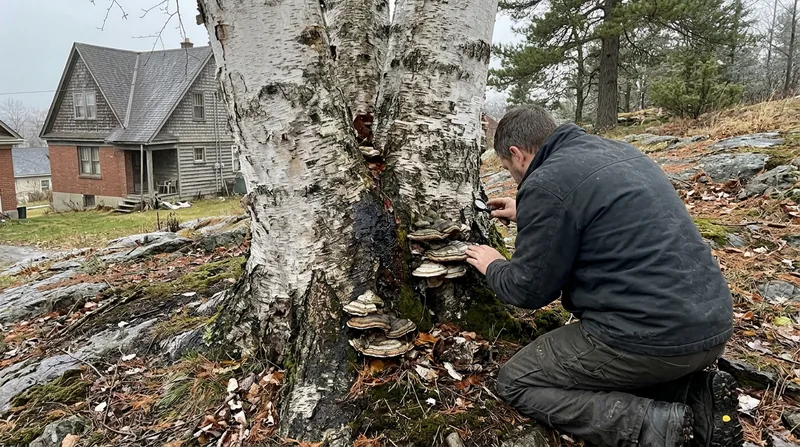
Homeowners in Sudbury neighbourhoods often call us after a tree has already lost a major limb. The earlier signs are quieter: thinning crown, early leaf drop, a shelf fungus at the base, or bark cracking on the south side. Catching these early gives the tree a real chance, and it gives you a clear picture of risk before a windstorm makes the decision for you.
- You notice dieback at the top of the crown that has grown over two or three seasons.
- Bark is peeling or cracked, or you see fungal growth near the root flare.
- Leaves are smaller than usual or turn colour ahead of the rest of the street.
- A tree leans or the ground around it heaves after heavy rain.
- You are planning a renovation and need to know which trees can be protected.
When several of these signs appear together, book an assessment rather than waiting for the next storm season.
For a broader look at how pruning supports tree health, see our tree pruning service, and for storm-related damage, our storm damage cleanup covers the aftermath.
When to book treatment in the Sudbury area
Timing matters as much as the diagnosis. Structural pruning and most disease inspections are best done in dormancy, from late fall to late winter, when the canopy is bare and problems are easier to see. Emerald ash borer injection runs from late spring to early summer. Cedar hedge trimming, which is a separate job, happens in late spring and summer.
If a tree has lost a limb in an ice storm or a summer windstorm, do not wait for the season to change. Call emergency tree removal for the dangerous part, then book a disease assessment once the site is safe.
Our crews work across Sudbury and French River, and we can usually schedule an assessment within a few days. Call (249) 806-5249 to arrange a visit, or use our contact page to request a free estimate.
Prices Tree Disease Treatment in Sudbury — Indicative pricing
| Service | Price | Details |
|---|---|---|
| Tree health assessment | From $175 | On-site diagnosis with written findings and treatment options |
| Sanitary pruning | From $325 | Removal of dead, diseased and crossing limbs |
| Emerald ash borer injection | From $275 | Per tree, timing depends on the season |
| Soil and cultural correction plan | From $225 | Aeration, mulching and watering recommendations |
| Removal and replacement | Quoted on site | Free estimate after assessment |
| Travel | Included | In Sudbury and the surrounding area |
| Estimate | Free | Reply within 24 hours at (249) 806-5249 |
Indicative prices; free, personalized estimate within 24h at (249) 806-5249.