



Tree pruning in Sudbury is not a cosmetic exercise. The city sits on the Canadian Shield, where shallow soil over bedrock, lake-effect snow and freeze-thaw cycles put every trunk under stress. Silver and sugar maple, red and white oak, birch, Norway spruce and black locust all grow here, and each species responds differently to a saw. Our ISA Certified Arborists have worked these lots since 2011, selecting cuts that keep a tree sound rather than simply shortening it. If you are comparing companies, start with the full pricing grid so you know what a visit should cost.
Why structural pruning matters on Sudbury properties
Most of the damage we see after a windstorm or an ice storm did not start with the weather. It started with a weak union, a co-dominant stem or a branch that had been left too long. On ravine lots and mature street trees in post-war subdivisions, those defects are often hidden 12 metres up. Correcting them early is cheaper than cleaning up after a failure.
- We remove dead, dying and broken limbs before they drop on a roof or a vehicle.
- We thin dense crowns so wind passes through instead of levering the trunk.
- We cut rubbing branches that open wounds and invite decay.
- We train young trees with a single leader so they hold up to snow load.
- We reduce long limbs over driveways, fences and service drops with directional cuts.
Each visit ends with the canopy lighter, the structure clearer and the risk lower than when we arrived.
Key fact: A mature silver maple in a New Sudbury backyard typically needs 8 to 14 cuts to clear deadwood and two weak unions. Booked as a single visit, that work usually runs $475 to $850 depending on access and height.
For the provincial framework on private tree care and property responsibilities, the in Sudbury and the surrounding area government publishes guidance at ontario.ca.
How our crews prune a tree, step by step
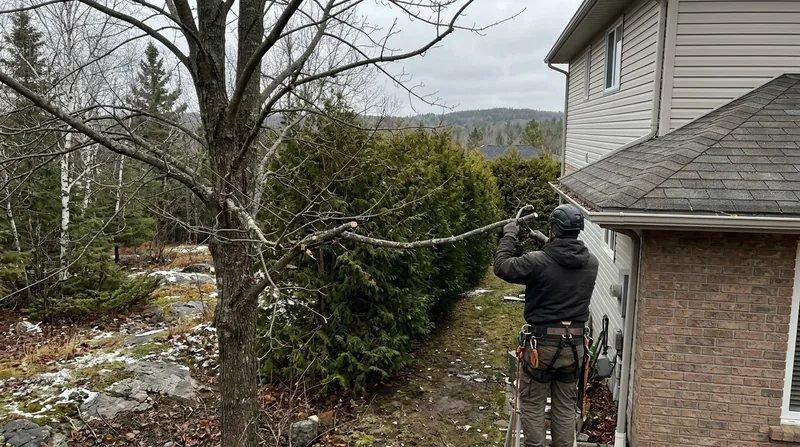
Every job starts with a walk-around. We look at the species, the soil, the lean, the targets below and the access. A tight backyard reachable only through a standard gate calls for a different plan than an open front lawn in the Flour Mill. The sequence below is the one we follow on every property.
- We inspect the tree from the ground and, where needed, from within the canopy.
- We identify deadwood, crossing limbs and weak unions to be addressed.
- We set up rigging and drop areas away from fences, sheds and service entrances.
- We make the cuts in the correct order, starting with the removal of deadwood.
- We shape the crown for balance and clearance, never for appearance alone.
- We chip the brush on site and rake the work area clean.
The result is a tree that looks cared for and, more importantly, behaves predictably in the next storm.
Key fact: On a ravine lot off a steep access in the Sudbury area, a full structural prune on a 60 cm sugar maple took our crew one day and produced four cubic metres of chips, all removed the same afternoon.
If the brush volume is large, we can leave the chips or haul them away; see brush chipping for the options.
Pruning methods we use, and when each applies
Not every tree needs the same treatment. The choice of method depends on species, age, defect and what sits underneath. The table below maps the four approaches we use most often to the situations where they make sense.
| Method | Description | Context |
|---|---|---|
| Crown cleaning | Removal of dead, broken and diseased limbs | Mature maples and oaks with accumulated deadwood |
| Crown thinning | Selective removal of inner branches to improve airflow | Dense crowns on birch and Norway spruce |
| Crown reduction | Shortening limbs back to a lateral branch | Trees crowding a roof, a fence or a service drop |
| Structural training | Early shaping of a young tree to one leader | Newly planted street and yard trees under 15 cm |
Matching the method to the tree is what separates a useful prune from a harmful one.
What local rules and site conditions mean for your prune
Pruning is rarely a permit item, but the surrounding rules still shape the job. The City of Sudbury may require a permit for a private tree removal, and the application is normally supported by an arborist report; pruning that keeps the tree alive usually sits outside that process, yet the same municipal rules and thresholds differ from one municipality to the next across the Sudbury area. Near a private electrical service entrance, we respect the required approach distances and plan every cut around them. The public distribution network of your local utility or Hydro One is never touched: if a limb is in contact with those lines, the file goes to the utility. We document the work with photos and dispose of every branch and chip we generate, so nothing is left at the curb.
For trees that need more than a prune, our tree removal service covers the next step, and an arborist report is available when a municipality or a buyer asks for one.
When to book pruning in the Sudbury area
Timing follows the tree, not the calendar on the wall. Structural work is best done while the tree is dormant, from late fall to late winter, when the canopy is bare and the defects are visible. Summer visits are reserved for deadwood removal, clearance work and anything urgent after a storm. Cedar hedges are a separate schedule, trimmed in late spring and summer. Emerald ash borer treatment runs from late spring to early summer on ash that are still standing. If you are unsure, a call to (249) 806-5249 settles it in a few minutes.
- Late fall to late winter: structural pruning on maple, oak, birch and spruce.
- Late spring to summer: cedar hedge trimming and ash injection.
- Year-round: deadwood removal and emergency response after ice or wind.
- Early spring: fruit tree pruning before bud break.
Booking in the dormant window also means shorter wait times and firmer dates.
Homeowners in the Sudbury neighbourhoods who compare two or three quotes often find the difference is in the clean-up and the documentation, not the hourly rate. Our deadwood removal page explains what a typical visit includes, and the service areas page lists the municipalities we cover.
Prices Tree Pruning in Sudbury — Indicative pricing
| Service | Price | Details |
|---|---|---|
| Young tree structural training | From $225 | Trees under 15 cm, single visit, one leader established |
| Crown cleaning on a mature tree | From $475 | Deadwood and broken limbs removed, up to 15 m |
| Crown thinning or reduction | From $650 | Selective cuts for clearance and airflow, includes chip removal |
| Large or difficult access | From $1,100 | Ravine lots, tight gates, rigging required |
| Travel | Included | In Sudbury and the surrounding area |
| Estimate | Free | Reply within 24 hours at (249) 806-5249 |
Indicative prices; free, personalized estimate within 24h at (249) 806-5249.