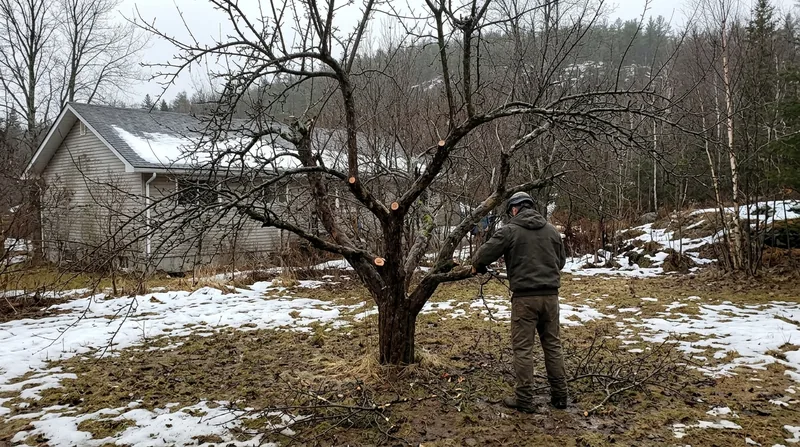




Fruit trees in Sudbury face a short growing season, late spring frosts and heavy clay soils that hold water well into May. Apple, pear, plum and cherry trees that go unpruned for three or four seasons produce dense canopies, weak crotches and small, disease-prone fruit. Fruit tree pruning in Sudbury corrects that trajectory. Our ISA Certified Arborists work in late winter, while the wood is dormant and the structure is visible, to open the canopy, restore airflow and set the tree up for a stronger crop. We have pruned backyard orchards from the Donovan to the ravine lots off the Kingsway, and we quote every job on site before a saw is started. For the wider pruning work we do on shade and ornamental trees, see our tree pruning service.
Why fruit trees need structural pruning in the Sudbury area
Most fruit trees on Sudbury properties were planted for shade or a few pies, not for production, and they have the scars to show it. Left alone, a standard apple or plum develops crowded scaffolds, upright water sprouts and shaded interior wood that never dries after rain. That trapped moisture is what feeds black knot on plums and cherries, and it is why so many backyard trees fruit only on the outer shell. Structural pruning removes the competition and lets light and air reach the bearing wood.
- We remove dead, damaged and crossing branches before they become entry points for canker.
- We thin the interior so morning sun dries the leaves and reduces fungal pressure.
- We shorten the heavy limbs that overhang roofs, driveways and hydro service drops.
- We shape young trees in their first five years so the scaffold is set before it hardens.
- We cut out black knot galls on plum and cherry with a margin of clean wood around each one.
Each cut is chosen for a reason: a leader to keep, a crotch to open, a limb that will never carry fruit without breaking. The result is a tree that is easier to spray, easier to pick and less likely to split under a load of ice or fruit.
Key fact: a mature apple tree in a Sudbury backyard typically takes 2 to 4 hours of pruning, and a small home orchard of six to ten trees is usually a half-day to full-day job. A single young tree shaped for structure generally runs from $150.
Municipal rules across in Sudbury and the surrounding area vary, so check the tree bylaws published by your municipality before removing a fruit tree. For a provincial reference on tree care and pest management, the in Sudbury and the surrounding area Ministry of Natural Resources forestry pages are a useful starting point.
How our crews prune a fruit tree
We prune in the dormant window, from late November through March, when the sap is down and the branch structure is fully visible. The work follows a set sequence so nothing is cut twice and the tree keeps its balance. On ravine lots with steep access, we rig limbs down rather than drop them, and we carry everything out through the same gate we came in by.
- We walk the tree with the owner and identify the scaffold limbs to keep and the ones to remove.
- We start with the three Ds: dead, diseased and damaged wood, cut back to healthy growth.
- We thin the interior to open light channels and reduce the density of the canopy.
- We head back the long, leggy limbs to bring the canopy down to a pickable height.
- We treat or remove black knot on plums and cherries, sterilizing tools between cuts.
- We chip the prunings on site and leave the property clean, or haul the brush away on request.
Every tree is assessed against its species, its age and the space it has to grow into, not against a fixed formula.
Key fact: a plum tree in a Val Caron backyard with black knot on three limbs is a typical call. We remove the galls in February, cut back to clean wood, and the tree pushes new growth in May without the infection spreading to the main scaffold.
If the work uncovers a structural weakness, we can support a heavy limb with tree cabling and bracing rather than remove it. For trees that are already failing, tree removal is the safer route, and we will tell you plainly which one applies.
Pruning methods we use on fruit trees
Not every tree needs the same treatment. A young tree in a new subdivision needs shaping, an old standard apple needs renewal, and a plum with disease needs a sanitation cut. We match the method to the tree and explain the choice before we start.
| Method | Description | Situation |
|---|---|---|
| Structural pruning | Selects and spaces scaffold limbs, removes competing leaders and weak crotches | Young trees in their first five years, and neglected mature trees |
| Thinning | Removes interior branches to increase light and airflow through the canopy | Dense apple and pear trees that fruit only on the outside |
| Renewal pruning | Cuts back old, overgrown wood to stimulate new bearing growth lower in the tree | Older standard trees that have grown out of reach |
| Sanitation cuts | Removes diseased wood such as black knot galls with a clean margin | Plum and cherry trees showing knots or canker |
| Restoration pruning | Rebuilds a canopy after storm damage or years of bad cuts | Trees broken by ice or wind across the Sudbury area |
We choose the lightest method that solves the problem, because a fruit tree pushed too hard in one season answers with a flush of water sprouts.
Permits, setbacks and cleanup around the job
Fruit tree pruning is routine work, but the site still has rules. The City of Sudbury may require a permit for a private tree removal, and an arborist report normally supports that application; pruning that keeps the tree alive generally falls outside that process, but rules differ from one municipality to the next across the Sudbury area, so confirm before any removal. Near the private electrical service entrance, we respect the required approach distances and keep our work clear of the wire from the pole to the house. A tree touching the public distribution lines is referred to your local utility or Hydro One, and we never work on that network.
Prunings are chipped on site and either left for mulch or hauled away, and the ground is raked and blown clean before we leave. We document the work and the condition of the tree for your records. If your plans touch a protected tree, our arborist report service covers the assessment the City may ask for.
What fruit tree pruning costs in Downtown and across the city
Price follows the number of trees, their size and how much dead or diseased wood has to come out. A single young tree shaped for structure starts at from $150, while a mature standard apple with several years of growth to correct runs higher. We quote on site so the number reflects the actual work, not a phone estimate. Our pricing page lists the ranges we work from.
Homeowners in Downtown, the Donovan and Uptown often have one or two trees in a tight backyard, while properties toward French River may have a dozen older trees along a fence line. Both are normal jobs for us. We schedule dormant-season work from late November onward, and the calendar fills first for February and March.
To book a free estimate, call (249) 806-5249 or use our contact page. We will walk the trees with you, explain what each cut is for, and leave you with a written quote the same day.
Prices Fruit Tree Pruning in Sudbury — Indicative pricing
| Service | Price | Details |
|---|---|---|
| Young fruit tree, structural shaping | From $150 | Single tree in its first five years, pruned to set scaffold limbs |
| Mature fruit tree, full pruning | From $275 | Apple, pear, plum or cherry with several years of growth to correct |
| Small home orchard (6 to 10 trees) | From $650 | Half-day to full-day job, includes chipping of prunings |
| Black knot removal on plum or cherry | From $225 | Sanitation cuts with sterilized tools and clean margins |
| Travel | Included | In Sudbury and the surrounding area, including French River |
| Estimate | Free | On-site assessment, reply within 24 hours at (249) 806-5249 |
Indicative prices; free, personalized estimate within 24h at (249) 806-5249.