The Pines That Rebuilt a Landscape
Drive almost anywhere in Sudbury and you will see them: dense stands of red pine and jack pine, often in straight rows, often on shallow rocky ground. Many of these trees date back to the regreening era, when large-scale aerial seeding and hand planting began restoring the hills around the city after decades of logging and smelter emissions had left the landscape bare. Those pines did their job well. They held the soil, shaded the rock, and helped the forest come back.
Fifty or sixty years later, the same trees are now mature, and many are overcrowded. Seedlings planted a few metres apart have grown into tight stands where crowns touch and lower branches die from lack of light. On a residential lot, that density creates real problems: windthrow risk, storm damage, and a buildup of dead material near homes and outbuildings. Understanding what you have is the first step. A red pine with its flaky orange-red bark and long needles behaves differently from a jack pine with its short needles and twisted form, and each needs a slightly different approach when it comes to Tree Pruning and long-term care.
Why Crowded Pines Need Thinning, Not Just Trimming
When pines grow too close together, they compete for water, nutrients and light. The weaker trees become stressed, which makes them more vulnerable to insects such as the pine engraver beetle and to root rot. In a crowded stand, a single windstorm can bring down several trees at once, and the ones that fall are often the ones a homeowner least wants to lose. Thinning is the practice of selectively removing trees so the remaining ones have room to develop strong trunks and healthy crowns. On a residential property this is usually done with a clear goal in mind: keeping the best-formed trees, opening sightlines, and reducing the fuel load near the house.
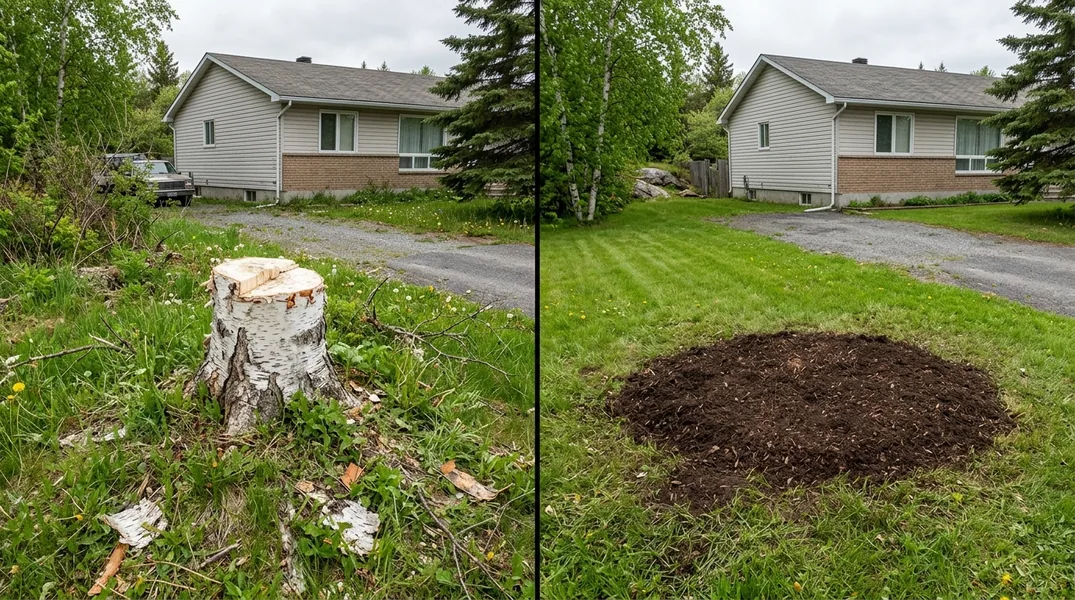
Thinning is also the moment to assess whether any tree has become a genuine hazard. A pine leaning toward a roof, one with a cracked fork, or one whose roots have been disturbed by excavation may need to come down. For that work, our crews handle Tree Removal with rigging and controlled drops, and we can grind the remaining stump so the area can be replanted or regraded. Homeowners sometimes ask about prices before anything else, which is fair: we provide a free estimate so you know the scope before any saw starts.
Pruning Red Pine and Jack Pine the Right Way
Pines are not like maples or oaks when it comes to pruning. They do not heal well over large wounds, and they do not sprout reliably from old wood. The safe window for structural work is late winter to early spring, before the candles (the new shoots) elongate. Removing dead, broken or crossing branches is always appropriate, and lifting the lowest limbs on a mature pine improves clearance for driveways, roofs and walkways. What you should avoid is topping or heavy live-branch removal: a pine that loses too much of its crown cannot replace it, and the result is a permanently stunted tree.
Red pine tends to hold a cleaner trunk and responds well to careful limbing. Jack pine is more irregular and often grows in clusters, so it benefits from early selection of a single leader. If your pines are within falling distance of a house, a garage or a hydro service line, have them assessed before storm season. Our ISA Certified Arborists can identify the defects that matter and recommend pruning that keeps the tree healthy rather than simply smaller. For anything near the private service entrance, we work only on clearance around the wire from the pole to your home, respecting the required approach distances, and we never touch the public distribution network.
Working With Acidic Soil and Rocky Ground
Sudbury's soils are often thin, acidic and stony, a legacy of the same geology and history that made regreening necessary. Pines tolerate these conditions better than most species, which is exactly why they were planted so widely. But tolerance is not the same as thriving. On a shallow soil over bedrock, root systems are restricted, and drought years hit harder. Mulching around the base of a specimen pine, keeping lawn equipment away from the trunk, and avoiding changes to the grade around the root zone all help. If you are planning to plant under or near existing pines, choose acid-loving species rather than trying to force a lawn that will struggle.
Acidic soil also affects how nutrients become available. A soil test is inexpensive and tells you whether lime or fertilizer is worth considering. In most established pine stands, the answer is to leave the soil alone and focus on reducing competition and compaction. Removing a few crowded trees often does more for the remaining pines than any amendment. When a tree does come down, Stump Grinding lets you reclaim the space without leaving a hazard, and the grindings can be used elsewhere on the property.
When to Call an Arborist in Sudbury
Some jobs are manageable for a careful homeowner with a pole saw: a low dead branch, a small limb over a path. Others are not. Any work near a roof, a fence, a shed or a service line should be handled by trained crews with the right equipment and insurance. The same applies to anything above roughly three metres, and to any tree that is leaning, cracked or partially uprooted after a windstorm. Our team serves properties across Uptown (Sudbury), Downtown (Sudbury) and The Donovan (Sudbury), and we see the same pattern again and again: a pine that looked fine in June becomes a problem after the first heavy snow or ice load.
It is also worth knowing that the City of Sudbury may require a permit for a private tree removal, and an arborist report can support that application. We can prepare documentation and photographs to accompany your request, and we document existing damage for your insurer if a storm has already caused problems. If you are unsure whether your pines need work, call Sudbury Tree Trimming Co. at (249) 806-5249 or request a free estimate. A short visit is usually enough to tell you whether thinning, pruning or removal is the right answer for your property.
Looking for a professional in Sudbury? Sudbury Tree Trimming Co. responds quickly for all your tree trimming needs.
Get a free estimateOur services : Tree Trimming · Tree Removal · Stump Grinding