Why Sudbury Trees Root Shallow: The Bedrock Reality
If you have ever tried to plant a garden or dig a post hole in Sudbury, you already know the truth: bedrock sits close to the surface across much of the city. The Canadian Shield is not a distant geological concept here. It is the reason your shovel stops 20 centimetres down, and it is the reason the trees on your property have adapted in ways that affect how they must be cared for.
Most tree species send roots outward rather than downward, but in rocky soil trees have no choice. With only a thin layer of soil over rock, the root plate spreads wide and shallow. A mature maple or birch may have roots extending well beyond the drip line, yet those roots may sit in less than 30 centimetres of soil. This shallow architecture is efficient for absorbing rain and nutrients near the surface, but it creates a tree that is, in a structural sense, less anchored than its height and canopy suggest.
This is not a defect in the tree. It is an adaptation to the local environment, and it is one that every property owner in Sudbury should understand before making decisions about trimming, removal, or construction near mature trees.
Shallow Roots and Windthrow Risk: What Homeowners Should Know
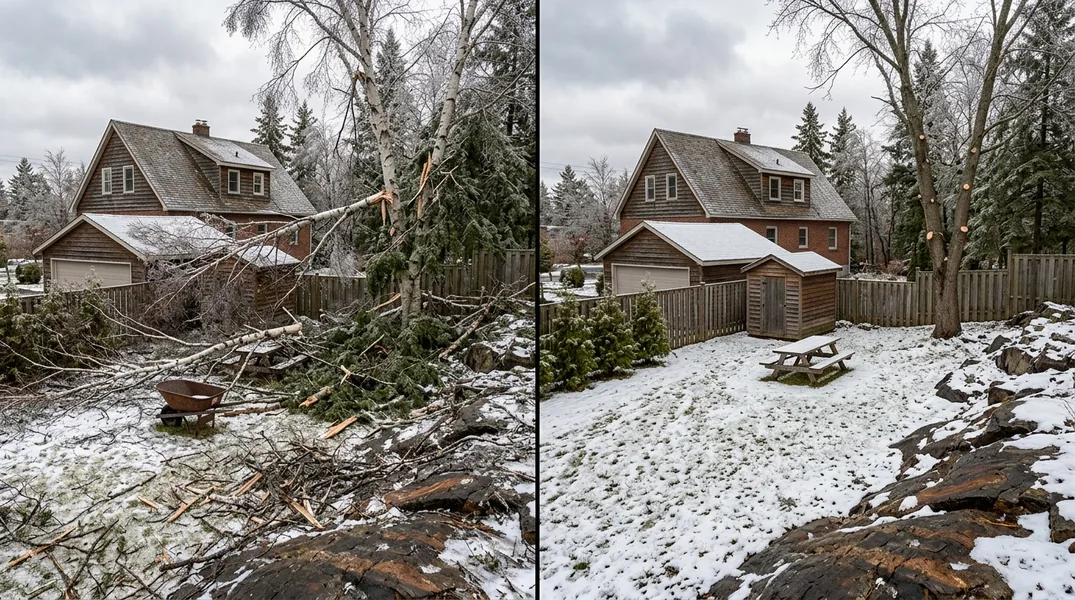
The most serious consequence of shallow rooting is windthrow risk. When a tree's root plate cannot grip deep soil, a strong gust can lever the entire plate out of the ground. In Sudbury, windstorms and ice storms are not rare events, and a shallow-rooted spruce or birch that has stood for decades can come down in a single afternoon. The risk increases when the soil is saturated after heavy rain, because wet soil offers even less resistance to a lifting root plate.
Windthrow is not only a problem for the tree. A falling tree can damage roofs, fences, vehicles, and neighbouring structures. It can also bring down private service lines, the wire running from the utility pole to your house. Our crews work only on clearance around that private service entrance and never on the public distribution network, which is the responsibility of your local utility or Hydro One. If you have a large tree close to your home or service line, a tree stability assessment is the responsible first step. Our ISA Certified Arborists can evaluate root plate condition, lean, and soil saturation to give you a clear picture of the risk before storm season arrives.
Leaning Trees in Sudbury: When to Worry and When to Watch
A leaning tree in Sudbury is common enough that many homeowners stop noticing them. Some lean because they grew toward sunlight in a crowded canopy. Others lean because the root plate has already begun to fail. The difference matters, and it is not always obvious from the ground. A tree that has leaned gradually over years is usually stable. A tree that has developed a new lean since last season, especially after a storm, deserves immediate attention.
Warning signs to watch for include fresh soil cracks or heaving at the base, exposed roots on the tension side of the lean, and a canopy that looks thinner than it did the year before. If you see any of these, do not wait. Call Sudbury Tree Trimming Co. at (249) 806-5249 for a tree stability assessment. In some cases, Tree Pruning can reduce canopy weight and restore balance. In others, Tree Removal is the safer choice, particularly when the tree overhangs a structure or a driveway. Our arborists will give you an honest recommendation based on the tree's condition, not on what is easiest to sell.
Tree Care on Rocky Soil: Practical Steps for Property Owners
Caring for trees on bedrock requires a different approach than caring for trees in deep loam. Watering should be slow and deep but not prolonged, because shallow roots cannot access moisture that drains past the thin soil layer. Mulching helps, but keep mulch shallow and wide rather than piled against the trunk. Avoid compacting the soil over the root zone with vehicles or heavy equipment, since compaction reduces the air spaces that shallow roots depend on.
Regular Tree Trimming is one of the most effective tools for managing risk on rocky sites. Removing deadwood, reducing long lateral limbs, and thinning the canopy reduces the sail area that wind pushes against, which lowers the load on a shallow root plate. It also improves the tree's structure over time. Our crews serve homeowners across Downtown (Sudbury) and Uptown (Sudbury), and we see the same pattern repeatedly: trees that receive regular structural pruning weather storms far better than neglected ones. If a tree has already been removed, Stump Grinding clears the site safely and allows you to replant with a species suited to the soil depth you actually have.
Permits, Documentation, and Choosing a Tree Care Provider
The City of Sudbury may require a permit for many private tree removals, and an arborist report is often part of that application. This is one of the clearest reasons to work with a company that understands the local process. Sudbury Tree Trimming Co. is a local, fully insured company, and our ISA Certified Arborists can prepare the documentation your application needs. We will not quote you a permit fee or a processing time, because those details come from the City, but we will make sure your application is supported by a proper assessment.
When comparing providers, ask about insurance, certification, and cleanup. A company that leaves debris or damages your lawn costs you more than the difference in rates. Ask for a free estimate in writing, and ask how the crew will protect your property during the work. For a straightforward assessment of your trees on bedrock, call (249) 806-5249 or request a free quote online. We serve homeowners throughout Sudbury and the surrounding municipalities, and we are happy to walk your property with you before any work begins.
Looking for a professional in Sudbury? Sudbury Tree Trimming Co. responds quickly for all your tree trimming needs.
Get a free estimateOur services : Tree Trimming · Tree Removal · Stump Grinding